EarthCal Evolves: Introducing the Auspicer
Earth Day 2026 marks the release of the most important EarthCal update yet—a new system that turns astronomical timing into meaningful, practical guidance rooted in ecology, ancestral knowledge, and human intention.

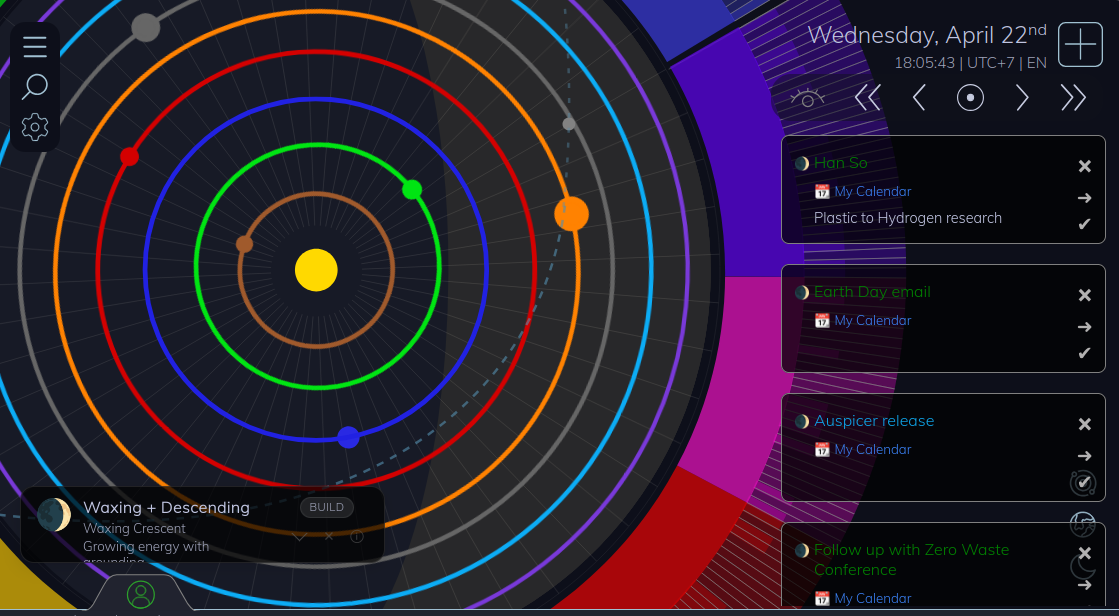
Today, on Earth Day 2026, I’m excited to announce a major new release of EarthCal.
This version marks an important step forward for the app. For the first time, EarthCal now includes the Earthen Auspicer: a new interpretive layer that transforms astronomical timing into practical, ecological, and cultural guidance. Rather than simply showing dates, phases, and celestial events, EarthCal now begins to answer a deeper question:
What does this moment mean, and how might we work with it?
At the heart of this release is a new a multi-layer system designed to synthesize astronomical signals, ecological patterns, ancestral knowledge, and human intention into actionable guidance. To name the system were drawing on the old Latin word auspices– the art of determining the character of a day. The Auspicer current architecture begins with a solar and lunar layers. Is the moon waxing or wanning? Is the sun or moon at apogee or perigee? Is the moon descending or ascending, full or new? Is the sun or moon within nodal eclipse windows?
This matters because time is not linear nor is it neutral.
All of these types of 'moments' have distinct effects on life on Earth.
Across cultures and across generations, people have observed that different moments (and their combinations) carry different qualities as cycles overlap and amplify one the other. Consequently, some lunar/solar moments are better for beginning. Some for harvesting. Some for gathering strength. Some for letting go. Some for just sitting back and reflecting. EarthCal has always sought to reconnect calendrical awareness with the living cycles of Earth.
With this release, that vision becomes much more tangible.
Our new Auspicer is not AI, and it is not astrology.
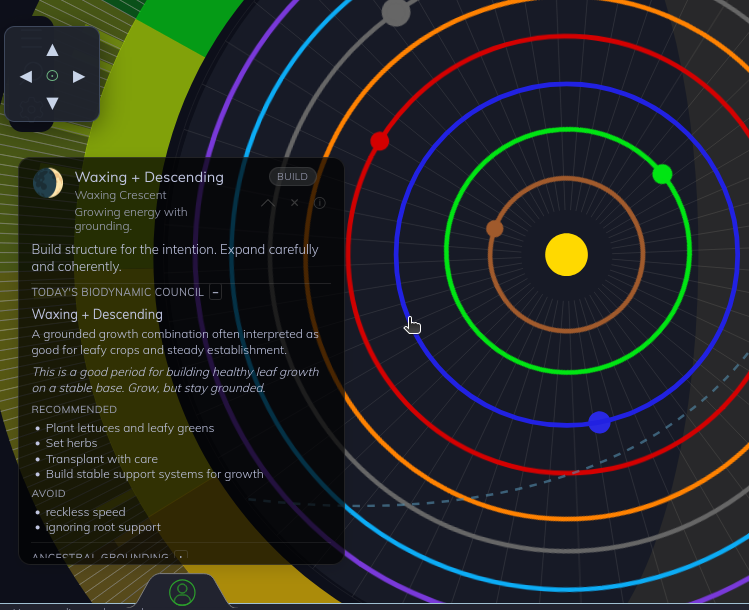
It is a carefully structured interpretive system built ontop of Earthcal's core astronomical calculations. On to it, we've add a layered framework of ecological and ancestral correspondences. The Auspicer window takes into consider lunar and solar positions to help users design their day, orient their attention, and work more consciously with the rhythms around them.
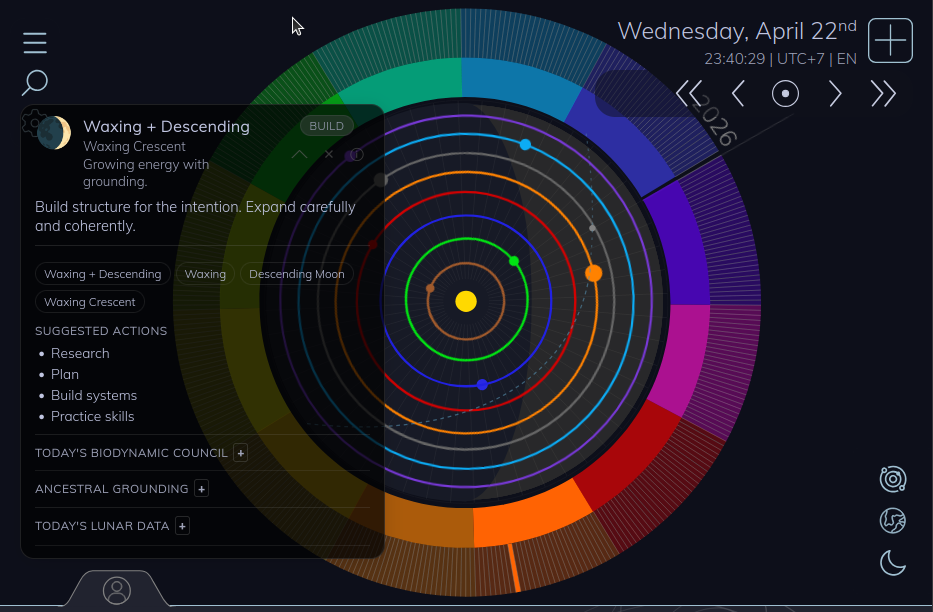
This release also lays the foundation for what EarthCal is becoming. Until now, the auspices system has been primarily lunar. But the engine has been designed as a broader synthesis model: one that can resolve signals across multiple layers, score their priority and semantic weight, and generate a clearer overall intention, supporting actions, and cautions. Solar integration is the next major step, followed later by planetary and seasonal layers. Think: an automated almanac based in astronomy and biodynamics
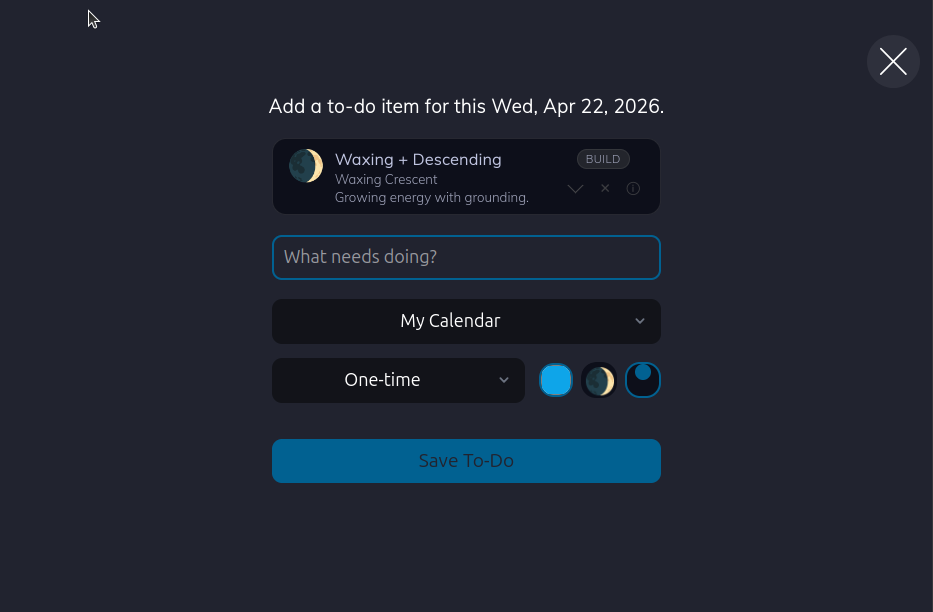
My hope is that this new version helps people do something simple but powerful: to see time differently. Not as an empty grid of abstract units, but as a living field of changing qualities. Moving beyond the traditional confines of calendar, in this sense, is not just a tool for scheduling and syncing.
Earth Day felt like the right day to release this work. EarthCal is, and always has been, an effort to bring human time back into conversation with Earth time. This new version brings that aspiration closer to reality.
Thank you to everyone who has supported the project, tested early versions, shared ideas, and encouraged its development. There is still much to build, but this release is a meaningful milestone—and I’m very happy to share it with you.
To celebrate Earth Day, this month, the Auspicer functionalities is available to both Jedi and Padwan users.
Check it out!

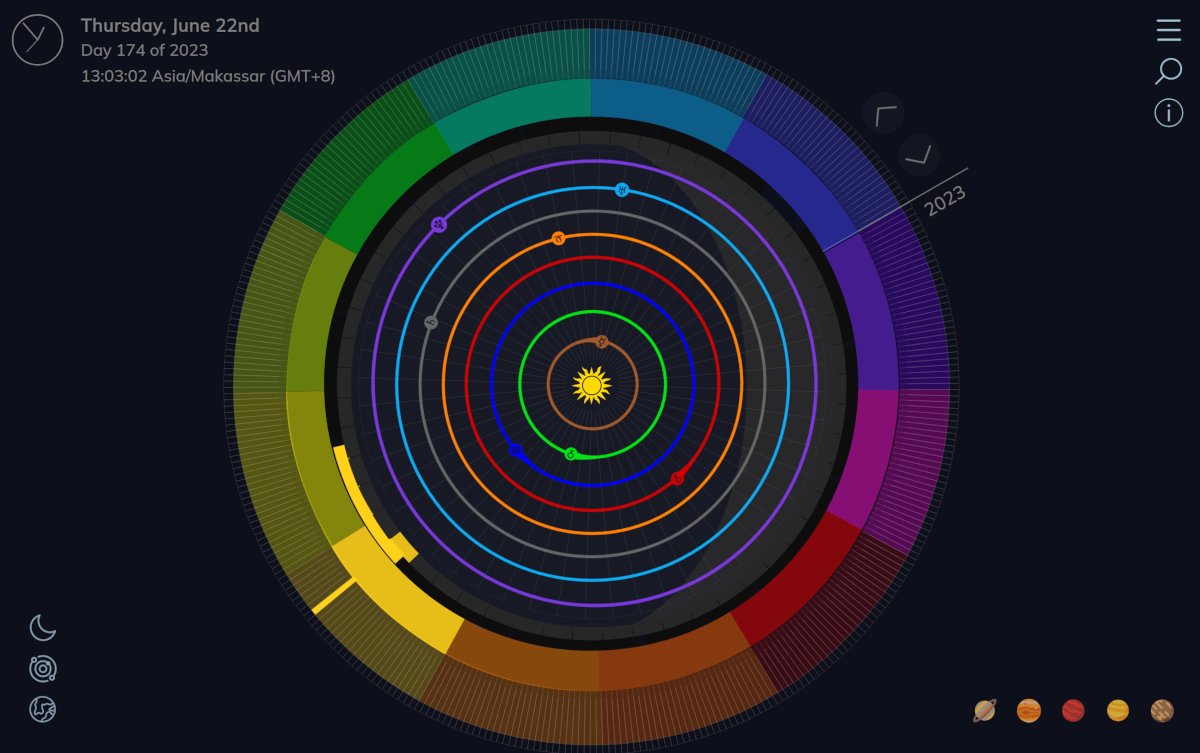
For Earthcal Ubuntu snap users, be sure to update your system to access the latest functionality.