Not Just an Eclipse: A Window into Lunar Alignment

Over the last 48 hours, the Sun and Moon aligned in just the right way to create a spectacular solar eclipse. Across parts of Greenland, Iceland and northern Spain, the Sun disappeared completely behind the Moon, while England and much of Europe experienced a dramatic partial eclipse.
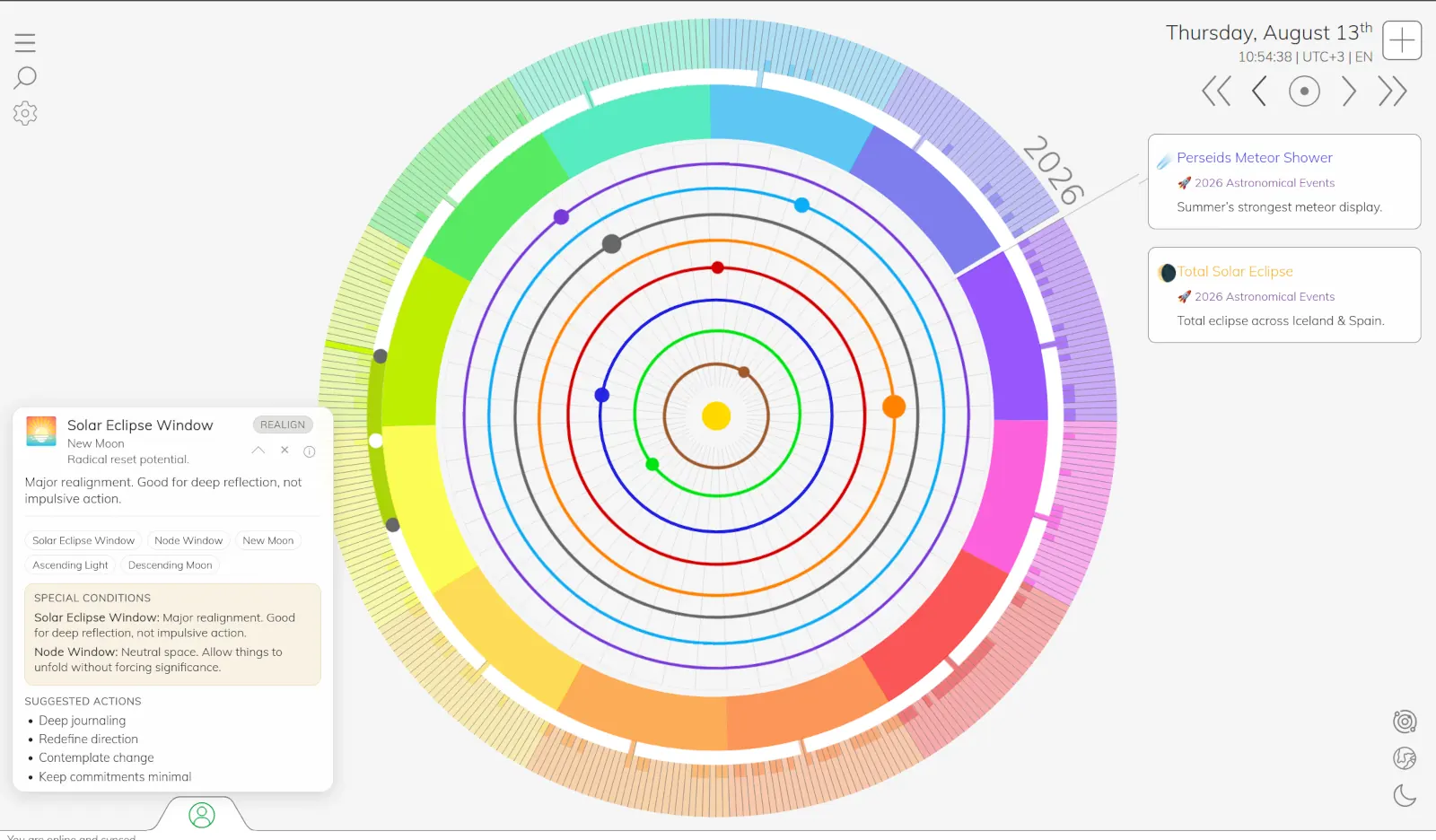
But for those of us who couldn't see it, that doesn't change the underlying celestial event: the Sun and Moon were still aligned in what, on Earthcal, we call a solar eclipse window.
For obvious reasons, watching the Sun disappear behind the Moon in the middle of the day had a tremendous impact on our ancestors. Across many cultures, eclipses accumulated profound spiritual, ceremonial and religious significance as moments of disruption, reflection, transition and renewal.
And judging by the plethora of eclipse articles popping up online this week—including this one!—they haven't exactly lost their power over our imaginations.
Aside from those who can make the journey to see an eclipse, however, most of us today simply talk about them and marvel at how spectacular they appear.
But these celestial alignments are more than spectacles. Eclipses occur when the Sun, Moon and Earth come into a uniquely precise alignment near one of the Moon’s orbital nodes—the two points where the Moon’s tilted orbit crosses the plane of Earth’s orbit around the Sun. During a solar eclipse, this happens at new moon, when the Moon passes between Earth and the Sun. Most new moons produce no eclipse because the Moon passes slightly above or below the Sun from our perspective; only when new moon coincides closely enough with a nodal crossing does its shadow fall upon Earth.
The sudden transformation of daylight during an eclipse has measurable effects on the behaviour of other creatures, while eclipses continue to exert unmistakable social and psychological effects on us humans: we gather, travel, celebrate, wonder and pay attention. Studies of eclipses have documented substantial behavioural responses among animals as their normal light-dark cues are abruptly disrupted.
Our ancestors built entire systems of observation around the intertwined cycles of the Sun and Moon.
So, of all those eclipse articles popping up this week, perhaps this one can help you deepen your own connection to those solar and lunar cycles!
Rather than letting these celestial rhythms pass with a but a glancing nod, why not begin consciously aligning your intentions with them?
The Moon has arrived on Earthcal
The timing couldn't be better, because a massive upgrade to Earthcal's ability to track the Moon is now complete and operational.
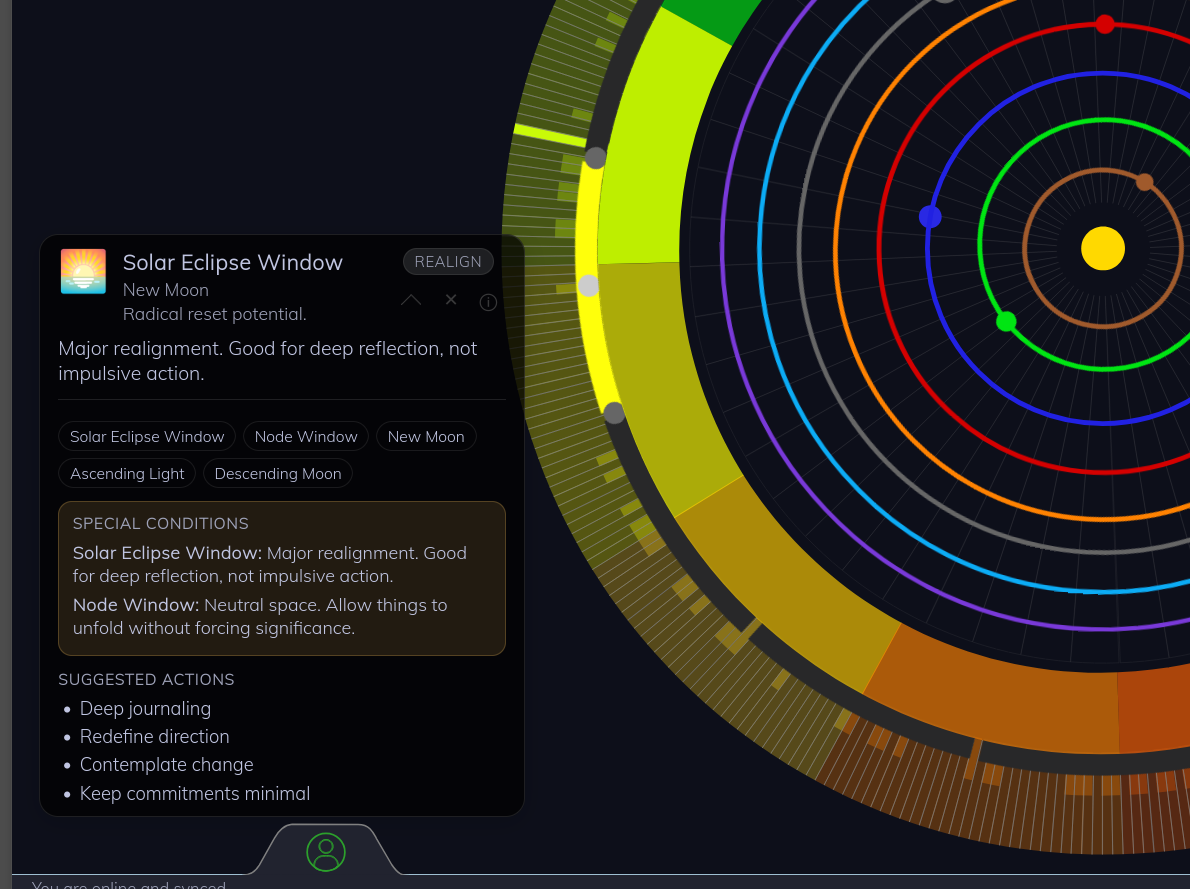
That said, the work on a massive upgrade to Earthcal ability to track the moon is now complete and operational.
Right from the beginning of Earthcal's development, I intended lunar cycles to be represented—and for users to be able to attach intentions to them.
This turned out to be way easier said than done.
In fact, it proved so challenging that I eventually had to drop lunar months from the calendar entirely for more than a year.
Did you know that the duration of a lunar month—the period between one astronomical new moon and the next—isn't constant? Although the average is about 29.53 days, individual lunations vary because of the changing orbital speeds of the Earth and Moon. Ack!
And things become even more challenging once human calendars enter the picture.
The astronomical new moon occurs at the same instant for the entire Earth, but that instant falls at different local times—and sometimes on different calendar dates—depending on where you are. Traditional lunar calendars can add another layer of geographical complexity because some determine the beginning of a month through the local visibility of the first crescent Moon.
Right from the beginning of the development of Earthcal, I intended that lunar cycles be represented and that users could attach intentioning to them! This was way easier said than done. In fact, it proved so challenging that I had to drop lunar months from the calendar entirely for over a year.
Needless to say, representing lunar months elegantly on a calendar, in such a way that it works for anyone, anywhere on Earth, became exceptionally challenging.
But after a year of slow and steady work, lunar months are now accurately represented on Earthcal for any given year, relative to your geographical location.
You can even flip ahead into future years and see how the lunar calendar unfolds—including lunar month names from the Islamic and Chinese calendars.
And best of all...
You can now seed intentions for lunar months
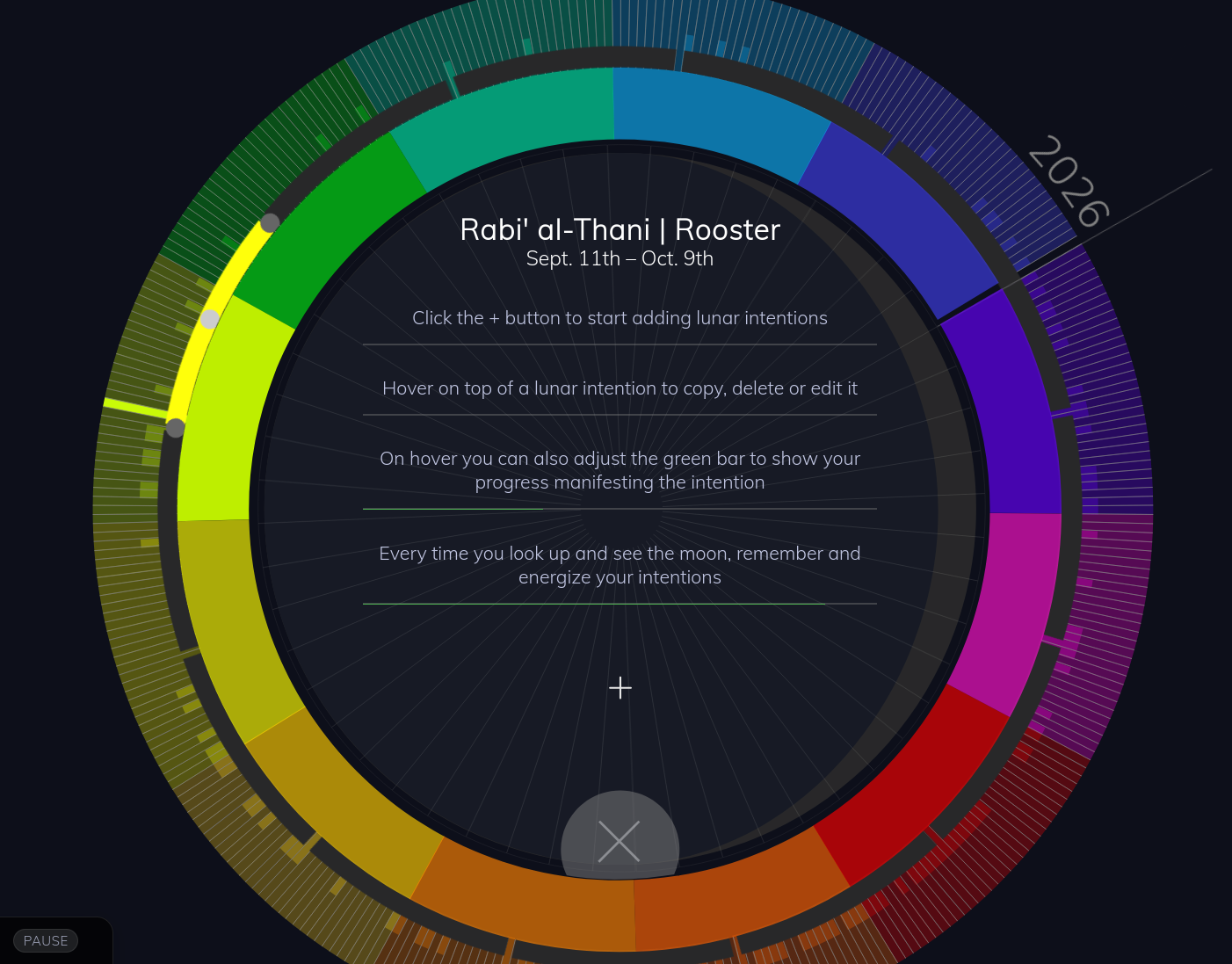
Simply click a lunar month's bar and an inner modal will appear where you can seed an intention for the month.
Then, as you move through the month, every time you notice the Moon in the sky it can become a reminder of that intention.
And every time you return to Earthcal to review your intentions, you can adjust the completion slider according to the degree to which your intention is manifesting.
In other words, the Moon becomes more than something beautiful overhead.
It becomes a recurring celestial reminder of what you are cultivating.
Lunar calendar functionally is normally a Jedi feature on Earthcal. But to get things rolling, for the next three lunar months it will be accessible to everyone.
Check it out:
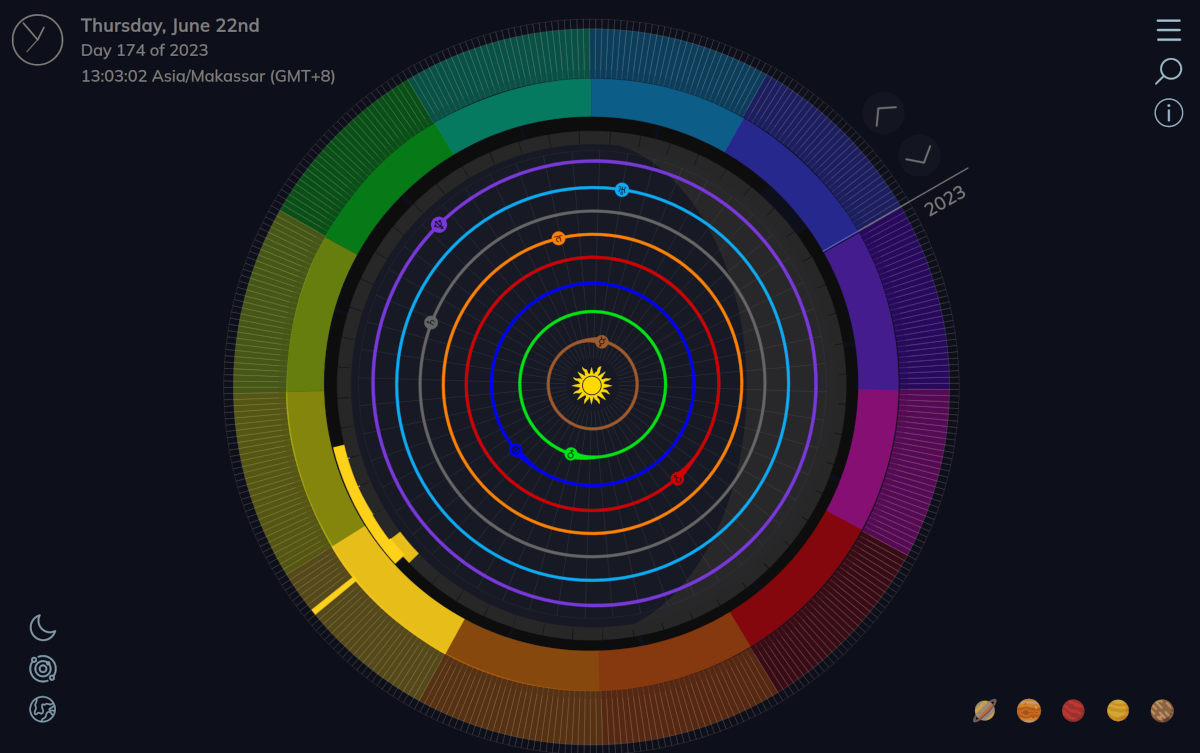
Seed an intention—and make the Moon and its phases your celestial personal coach.