The Problem of the Month


As concepts go, the modern month is about troubled as they get.
Like the air we breathe, time isn't something we often give much thought. Its easy to move through weeks, months, and years without questioning what they are and where they came from. It is only in rare and fleeting moments — like when the air is particularly fresh, or uncomfortably stale — that we pause and become aware of the air we are immersed in.
As things heat up around the world, as ecosystems deplete and plastics pollute, more and more folks are pondering how we have ever arrived at this civilizational moment. There's a whiff of something archaic in our modern moment, and it ain't particularly fresh! It is thus a good time to think about time. In particular, our units of time– the fundamental interface between us and the world.
I believe there's a deep correlation between our times and our time.
In my last essay, we took a deep dive into the stale and troublesome concept of the year.
As we saw, the concept of the 'year' is propped up with numerous calculations to connect it to Earth's spin around the sun. My conclusion was essentially this: a 'year' has been abstracted to prioritize mechanics over reality. I argued that this was to the great detriment of us and Earth.
That said, at least a 'year' attempts to connect to a real-world-actually-existing cycle.
In contrast, our modern 'month', has only the thinnest veneer of such pretense!
What is a month, exactly?
How is it defined?
What is it connected to?
Boom!
We've already hit the problem.
In our modern Gregorian calendar, the month has no definition at all. Its length varies arbitrarily from 28 to 31 days, with no rhyme or reason.
Well, that's not totally true.
There is a rhyme!
Thirty days has September,
April, June, and November;
All the rest have thirty-one,
Save February at twenty-eight,
But leap year, coming once in four,
February then has one day more.
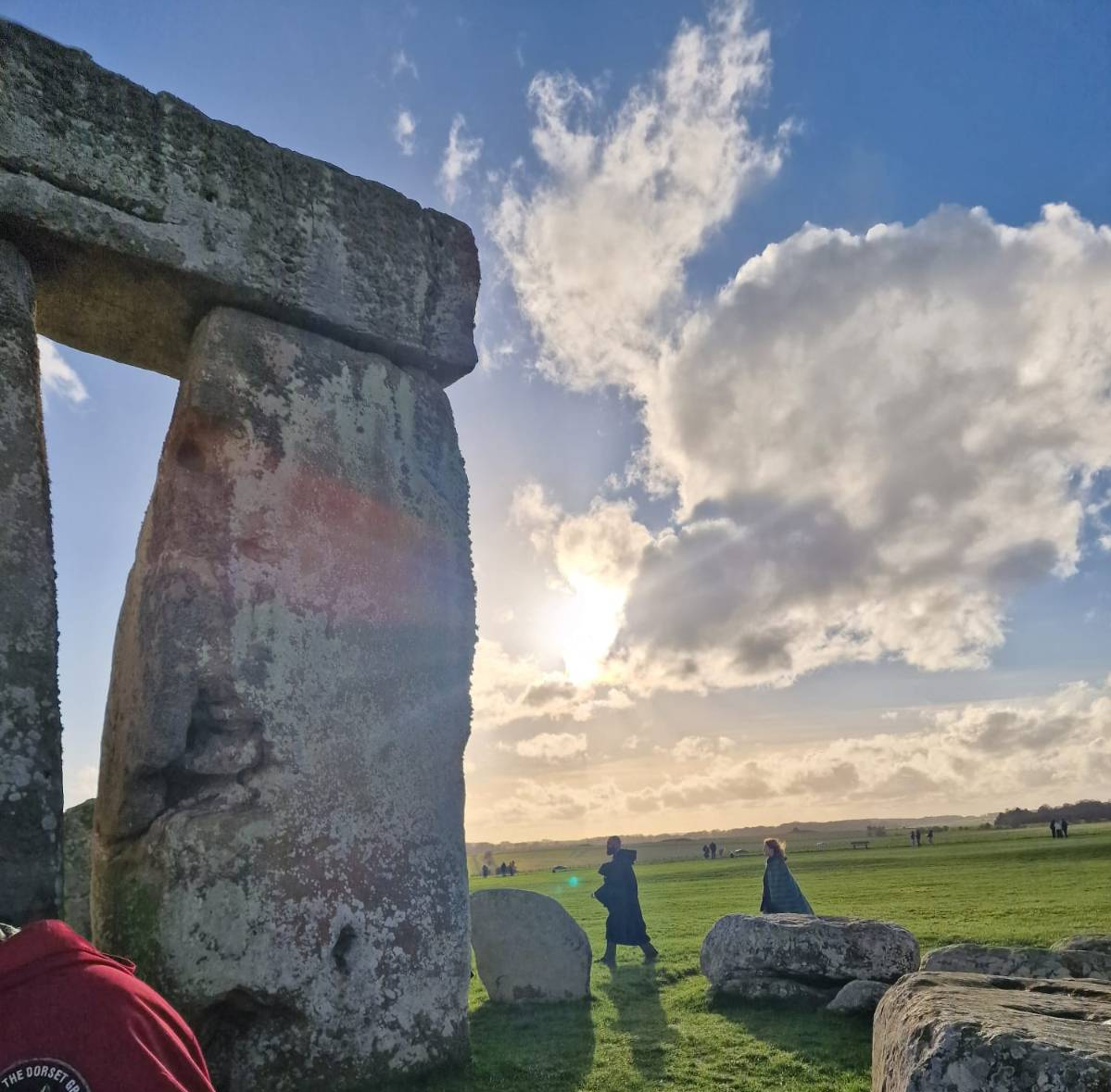
Unlike a real world cycles that we can observe with own eyes (the Solstice sun cresting over Stonehenge's capstone) or calculate mathematically (the orbital period of Venus), the irrational and ungrounded inconsistency of the modern month requires a rhyme to remember.
And yet the word itself tells a different story.
Month comes from "moon"– an "o" was taken out and a "th" added.
Linguistically, historically, and cosmologically, a month was never meant to be an arbitrary box of numbered days. A month was literally a Moon — a complete lunar cycle, from one New Moon to the next. A moonth (let's add the 'o' back in so we known which one we are talking about), was marked by visible phases that one could confirm simply by looking up into the night sky.

For most of human history, across cultures and continents, this was exactly how months worked. A moonth was a lived, shared, sky-based experience: the waxing crescent, the bright fullness, the slow waning, the return to darkness. Time was not counted — it was experienced. Time was experienced objectively and auspiciously. Afterall, the moon has tremendous impact on life here on Earth.
However, when it came to calendars, the lunar cycle does not fit in neatly with the solar cycle. A lunar cycle lasts approximately 29.53 solar days — not 28, not 30, but just in between. While this was no issue for most human civilizations, it kept things interesting! Lunar timekeeping needed to approximated. Some moonths were 29 days. Others were 30. This irregularity was not a flaw; it was an authentic reflection of reality.
Then there's the solar year.
As societies attempted to synchronize with both solar and lunar cycles, they hit another challenge of the year. Twelve lunar moonths total only about 354 days, falling short of the solar year of (365.251 days) by roughly eleven days. Thirteen lunar months overshot it, and twelve was too little! There was simply no clean division.
So what is a civilization to do?
Across the ages, great civilizations embraced this tension. Confronted by this profound planetary (dare I say 'cosmological') reality, civilizations responded based on their values– and in turn their values and culture was shaped by their choice.
Most cultures inserted extra days or months when needed. They accepted irregularity. They allowed priests, astronomers, or elders to mediate between celestial cycles and social order. Time remained elastic, negotiated, and visibly tied to the sky.
Then, in the first century BC, Rome made a different choice.
In 42 BC, shortly after Julius Caesar returned from Egypt, the question of the calendar came to a head. Rome’s old lunar calendar had become too complex and arbitrary in Ceasar's view to serve as the underpinning of the great, continent spanning empire that he was envisioning.
Egypt's example offered Caesar a solution.
The Egyptian civil calendar was strict, solar and definitive. It had held dominion over Egyptian life and empire for a thousand years– helping to hold the power of the Pharaohs and make their empire. It was radically simple: twelve months of thirty days, plus five extra days added at the end of the year. No lunar observation. No adjustment. No priestly discretion. It was a calendar designed not to follow the sky, but to run a state.
Inspired by this model, Caesar implemented his own.
The Julian calendar fixed the year at 365 days, introduced a leap day every four years, and standardized the lengths of months. The familiar structure of twelve “months” remained — but only as a fossil. Moonths became months– a mechanical and detached subdivision.
The moon was ditched.
It was a massive political, philosophical and cosmological shift. Many historians attribute it to the transition from Rome the republic to Rome the empire. More profoundly, the gains in predictability and administration was a profound Faustian bargain for power.
The ensuing temporal consistency enabled Rome to coordinate economically and militarily across time and space. Where before disparate regions operated on their own unaligned calendars, now military movements, account payments and elections could be scheduled to the day into the future, and recorded for the centuries into the past. However, the detachment from real-world-existential reality at the core of this systematization, would reverberate across the millennia.
Today, the remnants of Julius Caesar’s calendar reform — and its discordance from reality — remain. We see it in the very names of our modern months. Because two additional months were inserted into the Roman calendar, the original Latin numerical names of the months were thrown off. October refers to the eighth month by name (octo), though it is now the tenth. November means the ninth month, yet it is now the eleventh. December means the tenth month — not the twelfth. And, of course, July is named after Julius himself (and August after Augustus Caesar).
But it goes deeper.
Effectively, the Julian calendar sacrificed any lived relationship with both the solar cycle (my last essay!) and the lunar cycle. This foundation remains in the Gregorian revision in the 15th century. What had once been a visible, shared rhythm of darkness and light connecting humans and other living creatures around the planet, became an artificial mechanical construct. With Rome’s abandonment of the Moon, time was severed from direct lunar observation and experience. What had once been a living dialogue between us and Earthen cycles was replaced by an abstract grid—uniform, predictable, and administratively convenient.
As Roman society lived within this grid it slowly but surely affected the way that its people saw the world. A mechanistic view of the world began to emanate out of Rome– continuing on where the Egyptian empire left off. Time became something to command rather than participate in, something to schedule rather than experience. Over centuries, this bureaucratic scaffold hardened into cultural common sense: economics took precedence over ecology, continuity over cycles, and coordination over communion. What began as an imperial accounting tool quietly became the world spanning temporal operating system of Western civilization—training generations to inhabit a clockwork abstraction, while forgetting that time was ever something visible, rhythmic, and alive.

Yet you and I are not alone in our discomfort with this concept of time!
Over the last two thousand years, folks throughout the ages have recoiled at the same underlying problem: the modern month no longer corresponds to any lived or observable cycle of the Earth or sky. For women, it has seemed a literal lunacy that there was no calendrical accounting of the moon's cycle which entrained their own.
Consequently, over the last centuries, people have proposed and even implemented alternatives calendars.
In particular, when their civilizational air was getting stale!
In 1877, revolutionaries in France seized not just the republic, but the moment. Specifically rebelling against the roman and religious roots of the Gregorian calendar, they created a completely new base-10 system of time. They did away with all the archaic nomenclature. They created ten months with equal thirty-day blocks named for climate and agriculture. They even tried implementing hours and seconds in 100 unit increments! Alas, France was forced to abandon the system within a decade when ten-day weeks proved untenable.
After the second world war, international reformers brought proposals like the World Calendar to a United Nations committee, advocating perfectly uniform months for economic efficiency. The reform was endorsed by various countries and made it to the very highest levels of national and UN discussion (New Zealand even voted to adopt the calendar) — however, the plans ultimately stalled under political and religious pressure on Richard Nixon, who... nixed it!
In the societal uncertainty around the turn of the millennium and what it meant, José Argüelles advanced a radically different response: a 13-Moon calendar that explicitly restored lunar cycles and challenged industrial time at its roots. The calendar was founded on a specif mathematical ratio of time units, that differs fundamentally from the Gregorian calendar (but is the same as the Mayan calendar). Argüelles's calendar was deeply coherent, but was stalled in its adoption after mainstream interest in Mayan timekeeping faded after 2012.
However, let us not forget the many civilizations — ancient and ongoing — that never abandoned cyclical time in the first place!
Neolithic peoples aligned monumental architecture such as Stonehenge with solstices and lunar standstills. The Jewish calendar preserved a living lunisolar rhythm through continuous intercalation. The Islamic calendar continues to this day to set its months by when the crescent moon is first seen by an human observer. Mesoamerican cultures developed exquisitely layered calendrical systems that tracked solar, lunar, planetary and ritual cycles simultaneously. And countless Indigenous societies around the world have long synchronized their lives not to abstract months, but to ecological signals: rains and droughts, migrations and flowering, spawning seasons and harvest windows. In these traditions, time was not counted — it was participated in.
And there's the Chinese calendar!

For over three millennia, Chinese timekeeping has harmonized lunar months with the solar year through the careful insertion of leap months. Each month begins with a new moon, while the year is anchored to the solar cycle. Agricultural life, imperial ritual, and popular festivals — most famously the Lunar New Year — are synchronized to the interplay of moon and sun. This lunisolar system, is neither rigidly mechanical nor romantically irregular, but calibrated — an ongoing act of astronomical and cultural adjustment.
Taken together, these great cyclocentric civilizations and the reform movements of recent centuries converge on the same quiet realization: humans long to truly connect and harmonize to the Earthen cycles that we are a part.
The modern month feels wrong because it no longer corresponds to anything we can see, feel, or inhabit. With its foundation in ancient attempts at dominion, empire, ecological disconnect and lunar dismissal, it no longer resonates with the collective consciousness of humanity today. More urgently, it is becoming increasingly clear, that our disconnected and mechanistic time-paradigm is the root enabler of our modern civilization's inexorable depletion of the planet's biosphere.
But of course there's another temporal increment to consider!
It is one that has remained largely unquestioned and which sheds further light on these deep-set ontological issues.
The seven day modern week.
In my next essay, we will turn our attention to the problem of of the week.
Previous essay:
 Russell Maier